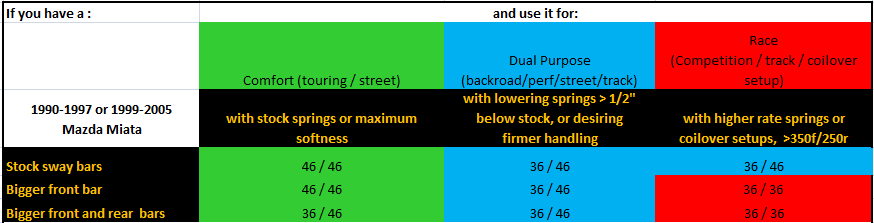
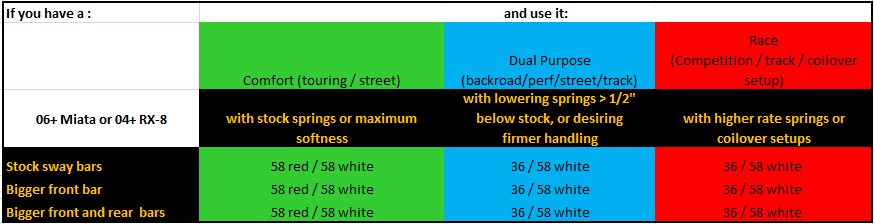
Bump stop selection matrix:
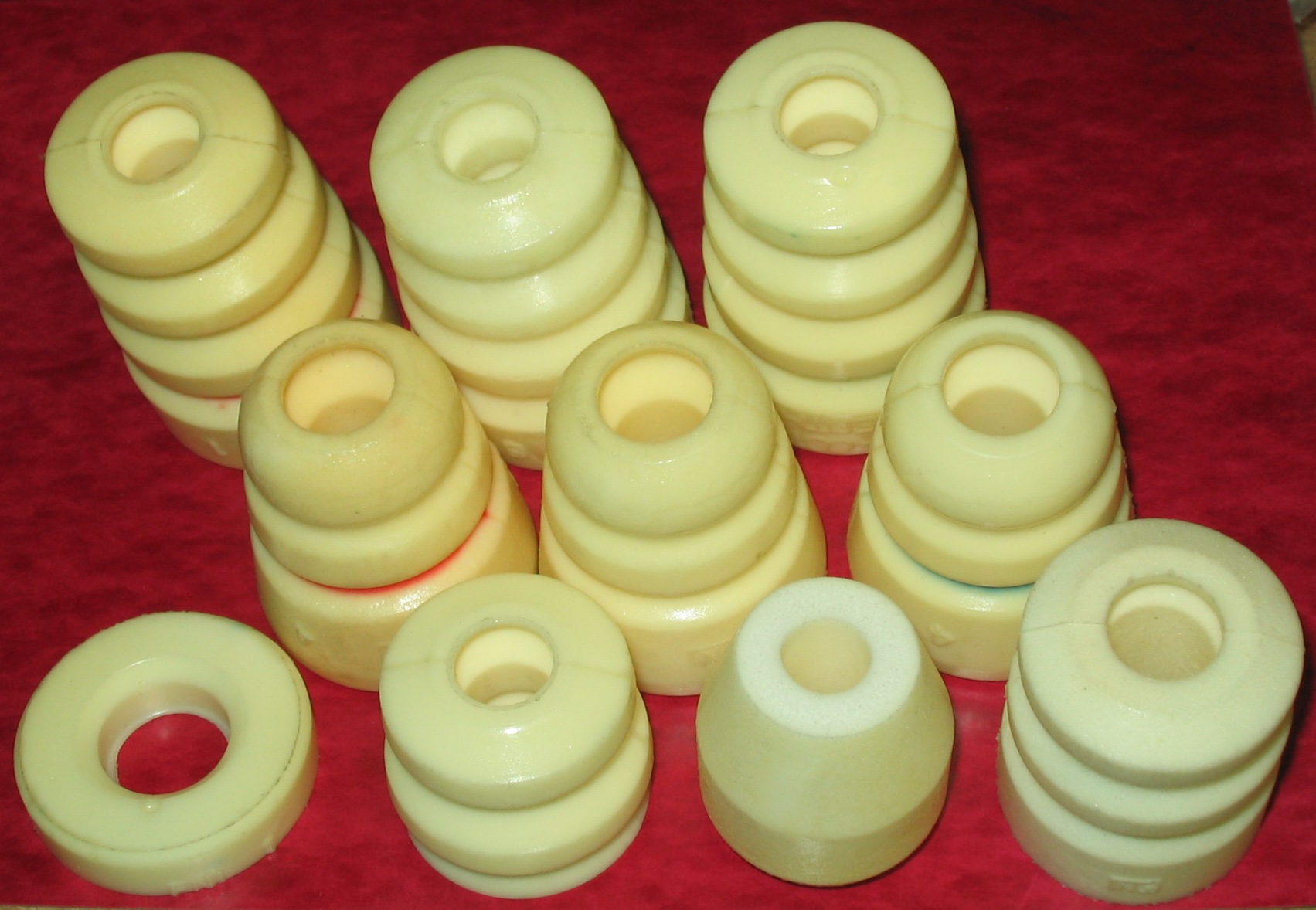
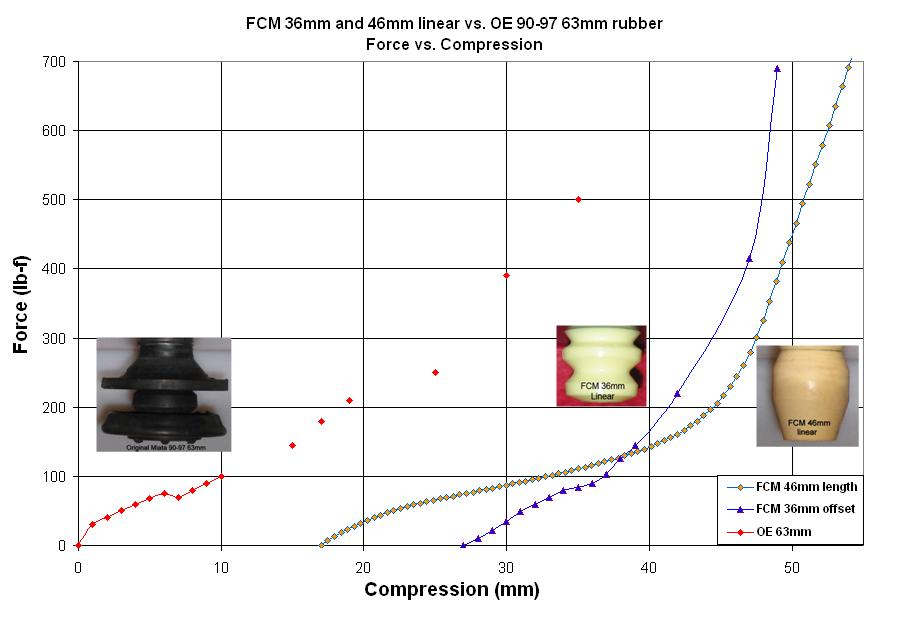
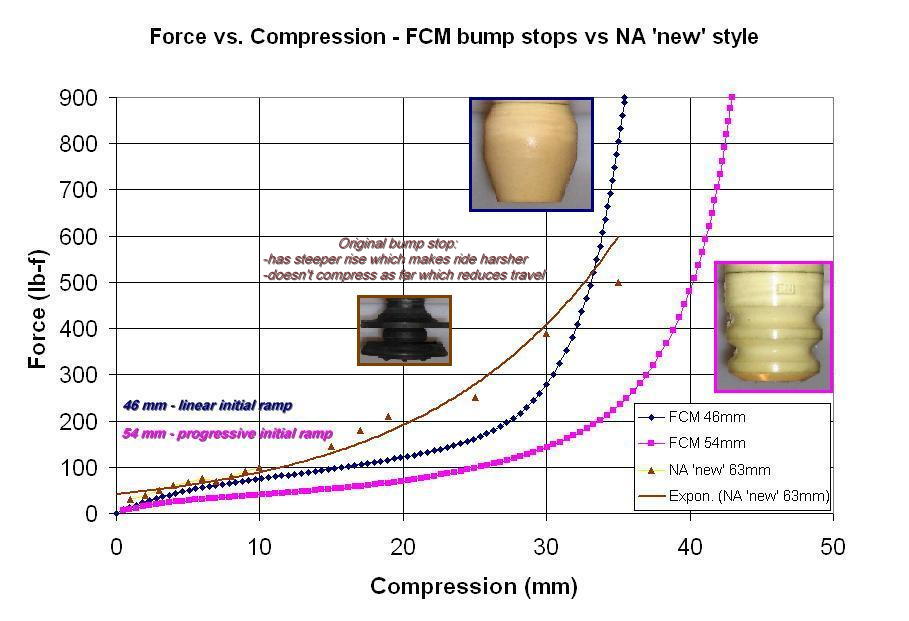
- FCM 36mm linear - for cars lowered 1/2" or more OR using front springs MORE THAN 250 lb/in OR for a sporty ride with stock springs. Recommended for very low cars with stiff springs (i.e. 300/250 or higher)
- FCM 46mm linear - for cars lowered 1/2" or more OR using front springs LESS THAN 250 lb/in OR for maximum suspension travel. Recommended with FCM shock mounts and stock springs
- FCM 36mm front/46mm rear - standard on FCM coil-over kits (above 250 lb/in front). Recommended for Flyin' Miata, Tein S-tech, or H&R springs
- FCM 54mm progressive - for cars at stock ride height with stock springs OR for a more comfortable ride
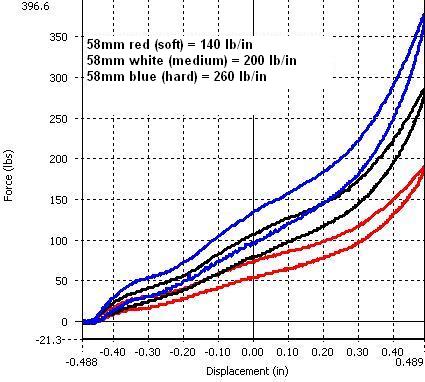
- FCM 58mm high-performance - available in red, white and blue (soft, medium, and hard) densities. For 1990-2008 Miatas with soft/stock springs AND drivers who want sporty ride/handling (i.e. backroads, autocross, track)
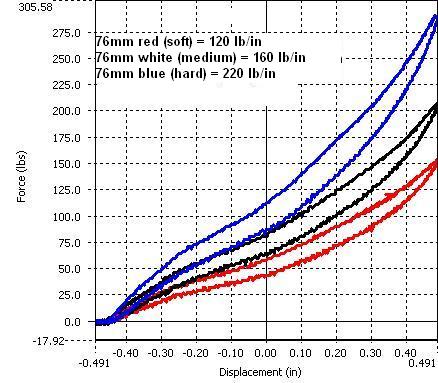
- FCM 76mm high-performance - available in red, white and blue (soft, medium, and hard) densities. For 2006+ Miatas as a replacement OE rear bump stop OR for custom applications (may be cut to varying lengths)
Shock absorber application guide:
90-97 Miata
- Bilstein R-pkg - original-equipment on the '93LE and '94-97 R-pkg, these are digressive, monotube shocks. Digressive means the forces decrease (or digress) at higher velocities. Digressive forces are important to prevent either rebound or compression forces from upsetting the chassis, either with too much compression (wheel jumps up over bumps) or too much rebound (wheel pulls down over bumps). The factory R-pkg shocks can be used with up to 450/350 lb/in springs as a budget race setup. A coarse revalve from Bilstein (usually only one or two internal shims changed) may be performed at a cost of ~$65 per shock. A custom FCM revalve is $150 per shock and shapes the entire damping curve based on vehicle + passenger weights, driving style and your typical roads.
- Background: very strong low-speed rebound damping and very weak low-speed compression
- Usage: Best suited to smooth roads or stiffer springs, up to ~450 lb/in front, 350 lb/in rear
- Revalve/rebuild? Can be revalved by Bilstein or FCM to achieve your goals. Bilstein revalves are less refined than what we can perform based on our modeling and customer interaction process
- Dyno graph:
- Bilstein HD - aftermarket, German-made, intended for 90-97 Miatas, may be adapted to 99-05 via FCM mounts
- Background: soft low-speed rebound and compression, although rebound increases very quickly. very strong low-speed rebound damping and very weak low-speed compression
- Usage: The valving was designed in Germany for German roads (which are smoother than most in the United States). Best suited to smooth roads or stiffer springs, up to ~450 lb/in front, 350 lb/in rear
- Revalve/rebuild? Can be revalved by Bilstein or FCM to achieve your goals. Bilstein revalves are less refined than what we can perform based on our modeling and customer interaction process
- Dyno graph:
- FCM custom Bilstein - based on either OE or aftermarket Bilstein shocks, valving is tailored to the customer's needs. A thorough phone interview is performed to determine optimal ride heights, spring rates, recommended front and/or rear sway bar, and alignment settings. No two customers are the same and one-size does not fit all
- Background: Based on the proven Bilstein monotube design. Our complete coil-over kits carry a MONEY-BACK GUARANTEE
- Usage: Can be built to any specs for any application, from street to autocross to high-speed road racing. May include single-adjustable (double-acting rebound/compression), double-adjustable (independent rebound/compression), with or without external reservoir
- Revalve/rebuild? Yes.
- Dyno graph: specific to each customer's needs. Dyno curves are only provided with adjustable shocks to show full range. We have dozens of esctatic customers comfortable with this policy
- Flyin' Miata AFCO - aftermarket, American(?)-made twin-tube, digressive character
- Background: Surprisingly, FM chose a degassed twin-tube for their high-end suspension. It does have independent double-adjustment of low speed rebound and bump which can be a nice tuning aid for the serious enthusiast. However, the lack of even a minimal gas charge and the inherent twin-tube design causes cavitation (foaming) of the shock oil with even moderate usage. Cavitation prematurely ages all internal components and must be avoided in any quality shock. The result is inconsistent performance over time, faster internal wear and diminished grip. Rebound can run soft (stock-like) to very strong, compression is fairly weak due to the reduced fluid capacity in bump due to the twin-tube construction
- Usage:
- Revalve/rebuild? Yes
- Dyno graph:
- JIC Magic FLT-A1 - aftermarket, Japanese-made monotube, digressive character
- Background: Very strong low-speed rebound, also fairly strong low-speed compression. Double-acting thru-rod bleed adjuster (low-speed rebound and bump together). Can work well for smoother lots and track but very harsh riding on the street, even on full soft
- Usage: Track, autocross on smoother lots, drift
- Revalve/rebuild? Yes
- Dyno graph:
- HKS Hipermax - aftermarket, Japanese-made monotube, linear valving
- Background: One of the nicer monotube shocks, though very strong rebound damping and somewhat soft compression. A good track or potential drift setup
- Usage: Track and competition mostly, has a very firm ride quality.
- Revalve/rebuild? Yes.
- Dyno graph:
- KYB GR2 - aftermarket, Japanese-made, twin-tube digressive shock. Non-adjustable.
- Background: not having measured one, we can only comment on user reports and marketing. It seems to be geared as a stock replacement.
- Usage: Stock springs only, not intended for lowering springs or performance applications.
- Revalve/rebuild? Not serviceable.
- Dyno graph: None
- KYB AGX - aftermarket, Japanese-made, twin-tube digressive shock with a single double-acting (rebound/compression) low-speed bleed knob
- Background: rebound is 3x stronger than compression throughout the shocks operating range. This causes jacking down and a rough ride over bumpy roads, though not as much as Bilstein R-pkg or HD.
- Usage: The damping is not very strong and our calculations indicate a maximum front spring of ~230 lb/in. These paired with stock springs or Tein S-tech would be the best compromise.
Note that ride quality will be less than Koni Sport (on softer settings), Tokico Illumina (also on softer settings), or an FCM-valved Bilstein.
- Revalve/rebuild? Not serviceable.
- Dyno graph:
- Koni Sport (also Koni Yellow) - aftermarket, Dutch-made, twin-tube digressive shock with a single double-acting (rebound/compression) low-speed bleed knob
- Background: designed as a stock-replacement, this shock works quite well with a stock spring except for having insufficient mid- and high-speed compression to prevent jacking. On stiffer rebound settings the shock is often used to 'control' stiffer springs. However, the control being exerted is only in the rebound direction so the result is jacking down, creating a loss of grip, unpredictable handling in the wet and reduced ride comfort. We used these shocks for 10 years and they served us well until we discovered monotube technology via Bilsteins and haven't looked back.
- Usage: For touring and sporty driving, we find 300 lb/in front, 220 lb/in rear springs is a good complement to the Koni damping. Higher rates are typically used for STS2, CSP and more dedicated track cars.
- Revalve/rebuild? At an authorized Koni center (no, we do not revalve Konis).
- Dyno graph:
- Koni DA (double-adjustable) - aftermarket, Dutch-made, twin-tube digressive shock
- Background:
- Usage:
- Revalve/rebuild? At an authorized Koni center (no, we do not revalve Konis).
- Dyno graph:
- Koni Race (same as revalved/shortened Koni Yellow) - aftermarket, Dutch-made, twin-tube digressive shock with a preload adjuster affecting the rebound damping.
- Background: the softest settings is nearly the same as Koni Sport. Extremely strong rebound, shown to cause extreme jacking down. Not recommended for rough roads or where ride quality and ultimate grip are desired.
- Usage: Minimum spring rates of 500 lb/in front, 300 lb/in rear from our best estimation.
- Revalve/rebuild? At an authorized Koni center (no, we do not revalve Konis).
- Dyno graph:
- Ohlins PCV -
- Background:
- Usage:
- Revalve/rebuild?
- Dyno graph:
- Ohlins DFV -
- Background:
- Usage:
- Revalve/rebuild?
- Dyno graph:
- Tein Basic -
- Background:
- Usage:
- Revalve/rebuild?
- Dyno graph:
- Tein SS -
- Background:
- Usage:
- Revalve/rebuild?
- Dyno graph:
- Tein Flex -
- Background:
- Usage:
- Revalve/rebuild?
- Dyno graph:
- Tokico Illumina - aftermarket, Japanese-made, twin-tube digressive shock with a thru-rod double-acting bleed adjuster affecting rebound and compression simultaneously
- Background: The Illumina has stock-like damping at the softer settings and since compression increases with rebound, it is able to prevent jacking down at higher settings. A downside is that since it is a twin-tube, there is a practical limit to how much compression can be generated via piston valve without causing hysteresis (non-ideal response).
- Usage: Stock springs on softer settings (e.g. 2f/1r) up to 450/300 springs (Ground Control/Illumina coil-over kit).
- Revalve/rebuild? No
- Dyno graph: